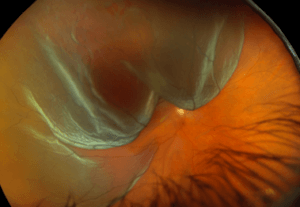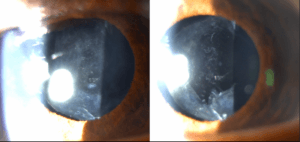

For years, patients troubled by eye floaters were often told simply to “learn to live with them.”
But advances in modern vitreoretinal surgery are changing the conversation.
Eye floaters are also known as Vitreous Floaters and Opacities (VFO). This term describes the visual symptoms caused by opacities, condensations, or structural changes within the vitreous gel, the clear substance that fills the eye. These can cast shadows on the retina and appear as spots, strands, cobwebs, rings, haze, or moving shadows, sometimes interfering with clarity, contrast, reading, driving, screen use, and overall quality of life.
At The Retina Clinic London, increasing numbers of patients are now seeking specialist assessment for symptomatic VFO. In carefully selected cases, a refined surgical technique known as Therapeutic Refractive Vitrectomy (TRV) may provide significant improvement in visual clarity.
Professor Paulo-Eduardo Stanga, Founder & Chief Medical Officer at The Retina Clinic London, says awareness of the impact floaters can have on daily life is growing rapidly.
“Historically, floaters were often dismissed as a minor inconvenience. However, for some patients they can become genuinely debilitating, affecting concentration, visual quality, work, and confidence. We are now much better at identifying which patients may benefit from treatment and, importantly, how to approach this safely using modern vitreoretinal surgical techniques.”
What Exactly Are Floaters?
Floaters are caused by opacities, condensations, or structural changes within the vitreous gel inside the eye. As the vitreous naturally changes with age, microscopic collagen fibres can clump together, and age-related vitreous changes can sometimes lead to posterior vitreous detachment, where the vitreous separates from the retina. These changes can cast shadows onto the retina and appear as moving shapes in the field of vision.
These visual symptoms are commonly referred to as Vitreous Floaters and Opacities (VFO) when they are persistent, symptomatic, or visually disruptive. The term reflects the fact that patients may experience not only classic moving spots, but also shadows, haze, veils, cobwebs, rings, and diffuse opacities that degrade visual quality.
Patients may notice:
- Cobweb-like strands
- Moving black or grey spots
- Rings or circles
- Cloudy or hazy patches in vision
- Shadows, haze, or veils that move with eye movement
While many floaters are harmless and become less noticeable over time, symptomatic VFO can remain persistent, intrusive, and visually debilitating.
A Growing Demand for Treatment
The rise in screen use, digital working environments, and heightened visual demands may partly explain why more patients are seeking assessment for floaters than ever before.
“Patients today are often spending long hours looking at bright screens or working in visually demanding environments,” explains Professor Stanga. “Even relatively subtle vitreous opacities can become extremely noticeable under these conditions. What matters is not simply whether floaters are present, but whether they are affecting a patient’s quality of life.”
For many patients, the impact of symptomatic VFO is not always reflected by a standard vision chart. A patient may have good visual acuity but still experience disabling shadows, haze, glare, reduced contrast, or moving opacities that interfere with reading, driving, screen use, concentration, and work.
From Observation to Advanced Surgery
Not all floaters require treatment. Some patients are best managed with monitoring alone, while others may benefit from YAG laser vitreolysis for selected discrete floaters, such as centrally located Weiss rings.
However, for symptomatic, visually significant, or diffuse vitreous opacities, TRV may be considered. This procedure involves removing the central vitreous gel containing the floaters using advanced vitrectomy techniques.
Unlike traditional vitrectomy surgery performed for retinal disease, TRV is specifically tailored towards improving visual quality in patients with debilitating symptomatic VFO. The technique is designed to remove the central vitreous responsible for visual disturbance while preserving peripheral vitreous where possible. This avoids unnecessary removal of peripheral vitreous and supports a highly targeted approach to treatment.
Precision Retinal Surgery
At The Retina Clinic London, patients undergo detailed vitreoretinal imaging and examination before any treatment is considered. This includes advanced OCT imaging, ultrawidefield retinal assessment, careful peripheral retinal examination, and evaluation of retinal safety.
Patients with symptomatic Vitreous Floaters and Opacities may also undergo the clinic’s SK-VFO testing procedure. This objective floaters assessment helps evaluate the presence, pattern, and visual impact of vitreous opacities, supporting a more precise treatment plan.
The findings help determine whether monitoring, YAG laser vitreolysis, or Therapeutic Refractive Vitrectomy is the most appropriate pathway for the patient. This ensures that treatment decisions for VFO are guided by detailed clinical assessment and SK-VFO objective testing.
TRV is performed in the clinic’s dedicated onsite surgical theatre using modern vitreoretinal surgical systems.
When Floaters Need Urgent Assessment
Although most floaters are benign, sudden onset floaters associated with flashes of light, a curtain-like shadow, or sudden vision loss can sometimes indicate retinal tears or retinal detachment.
These symptoms should always be assessed urgently.
Looking Ahead
As understanding of vitreous disorders continues to evolve, specialists believe attitudes towards floaters are beginning to change.
“We are increasingly recognising that visual quality matters,” says Professor Stanga. “For carefully selected patients, modern vitreoretinal surgery can offer meaningful improvement when floaters are having a significant impact on daily life.”
For patients experiencing symptomatic eye floaters, commonly referred to as Vitreous Floaters and Opacities, specialist assessment can help define the cause, measure the visual impact, and identify the most appropriate treatment pathway.
To book your consultation, please call us on +44 (0)20 4548 5310. We’ll be glad to guide you through the next steps.