Dry AMD needs careful monitoring
Dry age-related macular degeneration, commonly called dry AMD, affects the macula, the central part of the retina used for reading, recognising faces and seeing fine detail.
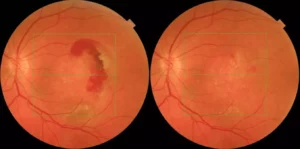
In early and intermediate dry AMD, small deposits called drusen can build up beneath the retina. Over time, some patients may develop thinning or loss of retinal cells. In more advanced cases, this can progress to geographic atrophy, where areas of the retina become damaged.
Dry AMD often progresses slowly, but it should not be ignored. Careful monitoring helps identify change early and allows patients to understand their options.
What symptoms can dry AMD cause?
Dry AMD may cause:
- Difficulty seeing fine detail
- Blurred central vision
- Reduced contrast
- Trouble reading in low light
- Distortion
- A dark or missing area in central vision in more advanced disease (sometimes called Geographic Atrophy (GA))
Some patients have early dry AMD without obvious symptoms, which is why retinal imaging can be valuable.
What is geographic atrophy?
Geographic atrophy is an advanced form of dry AMD. It occurs when cells in the macula gradually degenerate and die, creating areas where retinal tissue no longer functions normally.
This can affect central vision and daily activities such as reading, recognising faces and navigating unfamiliar places.
The term can sound alarming, but careful assessment can provide clarity about the stage of disease, the rate of change, and whether any treatment or monitoring pathway may be appropriate.
How we assesses dry AMD
At The Retina Clinic London, dry AMD assessment may include:
- High-resolution optical coherence tomography, known as OCT
- OCT angiography to assess retinal blood flow
- Ultra-widefield retinal imaging
- Fundus autofluorescence, which can help identify areas of retinal stress or atrophy
- Functional testing where appropriate
This detailed approach helps build a clearer picture of retinal health and disease progression.
What treatment options are available?
Treatment depends on the stage and type of dry AMD. For some patients, management may include lifestyle advice, nutritional support and regular monitoring.
For selected patients with early or intermediate dry AMD, photobiomodulation may be discussed. This is a non-invasive light-based therapy designed to support retinal cell function.
For patients with geographic atrophy, newer treatment pathways and clinical trial opportunities may be relevant in selected cases. Suitability depends on the individual eye, the pattern of atrophy, overall health, and regulatory or access pathways.
We also have experience in clinical research for dry AMD and geographic atrophy, helping patients understand whether trial assessment may be appropriate.
Why early assessment matters
Dry AMD can be complex. Some patients remain stable for long periods. Others may progress or develop wet AMD, which requires prompt treatment.
Regular specialist monitoring can help detect changes earlier and give patients a clearer plan.
The next step
If you have been told you have dry AMD, drusen or geographic atrophy, a specialist retinal consultation can help clarify your stage of disease and the options available.
To book your consultation, please call us on +44 (0)20 4548 5310 or visit https://www.theretinacliniclondon.com/book-a-consultation/
We’re here to help.